
Why Fad Diets Fail: A Clinical Perspective on Long-Term Weight Management

Medical Disclaimer: The information provided in this article is for educational purposes only and should not replace professional medical diagnosis, evaluation, or treatment. All treatments at Hemlock Clinic are prescribed based on individualized clinical assessment.
Medically Reviewed By: Dr. Manpreet Sran, MD | WA Medical License: #MD61284725 View Full Clinical Profile
When you drastically cut calories, your body does not know you are simply trying to lose weight; it interprets the sudden energy deficit as starvation. To conserve fuel, your central nervous system immediately slows down your resting metabolism.
This means that when the diet eventually ends, your body burns far fewer calories to maintain basic functions than it did before you started. Regaining the weight is not a failure of willpower or discipline. It is a predictable, physiological response to a down-regulated metabolism. Achieving sustainable weight loss means medically repairing this internal system, rather than repeatedly restricting your calories.
The Biological Reality of Yo-Yo Dieting
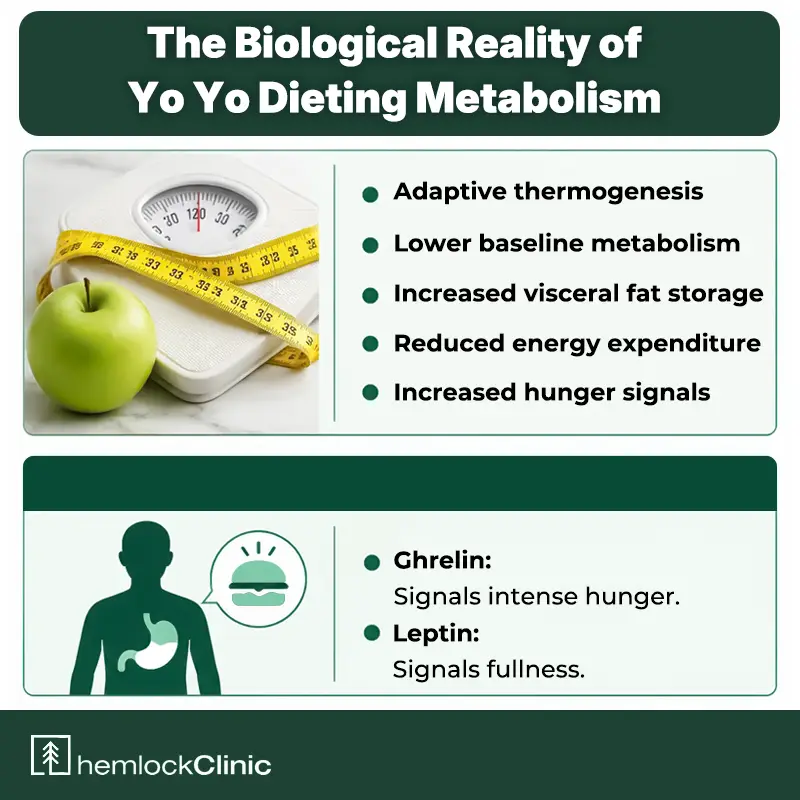
To understand why extreme diets backfire, it is necessary to look at how human biology manages threats. When you drastically reduce what you eat, your body enters a protective state. It becomes highly efficient at holding onto every single calorie you consume.
Because your baseline metabolism has dropped to protect your vital organs, returning to a normal, healthy diet causes rapid weight gain. Your body stores these new calories directly as belly fat to prepare for the next perceived period of restriction. This is the hidden trap of chronic dieting: every cycle of extreme restriction physically alters how your body processes energy.
“Clinical data from The Obesity Society demonstrates that adaptive thermogenesis (metabolic slowdown) persists long after a restrictive diet ends. The body actively down-regulates energy expenditure while simultaneously increasing hunger signals, making weight regain highly likely without medical intervention.”
How Extreme Diets Disrupt Hunger Signals
A severe diet does not just slow down your internal engine; it actively disrupts the chemical signals between your digestive system and your brain.
When you restrict calories too heavily, your stomach produces an excess of ghrelin (the hormone responsible for signaling physical hunger). At the exact same time, it drops your levels of leptin (the hormone that tells your brain you are full and satisfied). You are not fighting a bad behavioral habit. You are fighting a chemical drive to eat, controlled entirely by hormones that have been thrown off balance by extreme restriction.
The Hidden Medical Risks of Rapid Weight Loss
Aside from the frustration of regaining weight, repeating this cycle inflicts structural damage on your body. One of the primary medical risks of crash dieting is losing active muscle instead of fat.
When deprived of adequate energy, the body often breaks down active muscle tissue for fuel before it burns stored belly fat. Because muscle tissue is the primary driver of your resting metabolism, losing it impairs your ability to stay lean over the long term.
Protecting yourself from this damage requires stepping away from extreme restrictions. By identifying exactly what is blocking your weight loss, a clinical focus on prevention ensures you do not inflict permanent stress on your cardiovascular and endocrine systems.
Commercial Diets vs. Medical Weight Loss Programs
Standard commercial weight loss programs often fail because they rely on generalized math. They use digital apps to estimate how many calories you should eat based on simple age and weight charts, without accounting for your internal blood chemistry.
A clinical program treats weight resistance as a highly individualized medical issue. As a leading medical diagnostic provider in the Greater Seattle area, Hemlock Clinic uses objective lab results to treat the specific biological roadblocks keeping you stuck.
Diagnostic Comparison: Commercial Tracking vs. Clinical Intervention
| Program Focus | The Commercial Diet Approach | The Hemlock Clinical Approach |
| Metabolic Rate | Estimates daily calorie burn using generic mathematical formulas. | Evaluates exact thyroid and cellular energy markers via blood work. |
| Appetite Control | Suggests drinking water or “mindful eating” to ignore physical hunger. | Addresses leptin and ghrelin imbalances through targeted medical therapy. |
| Success Metric | Focuses solely on short-term scale weight reduction. | Focuses on preserving muscle mass and resolving insulin resistance. |
Comprehensive Testing: Finding the Root Cause

Real, lasting weight management starts in the laboratory, not the kitchen. We cannot repair a down-regulated metabolism without mapping exactly where the biological breakdown is occurring.
At Hemlock Clinic, our diagnostic process includes advanced blood panels that evaluate markers well beyond a standard wellness check:
- Comprehensive Thyroid Panel: We evaluate your active hormone levels (Free T3/T4) to detect a sluggish metabolic engine.
- Fasting Insulin & A1c: We analyze how your cells process sugar to identify if cellular resistance is blocking fat burning.
- Cortisol Markers: We evaluate physiological stress levels to ensure chronic tension is not forcing your body to store abdominal fat.
Achieving Long-Term Management Safely
Based directly on your laboratory metrics, Dr. Manpreet Sran implements a targeted treatment plan. This may include prescription medications, hormone optimization, and close clinical oversight designed to repair your metabolism and facilitate sustainable fat loss.
Consider a recent 38-year-old patient who had spent a decade cycling through extreme low-carb diets. Despite eating fewer than 1,000 calories a day, her weight remained stagnant. Our comprehensive panels revealed that chronic dieting had induced severe reverse T3 dominance (her body was actively blocking thyroid hormone to conserve energy) alongside clinical insulin resistance. By introducing a targeted GLP-1 receptor agonist to correct the insulin response and providing specific thyroid support, we safely restored her metabolic baseline. She achieved a 30-pound fat reduction over six months without starvation.
These specialized treatments are integrated into a cohesive patient care plan. By addressing the actual cellular mechanics, medical weight loss provides the biological correction that commercial diets simply cannot offer.
Breaking the Cycle of Dieting with Clinical Care
The physical toll of chronic dieting is significant. Blaming yourself for a biological survival mechanism only perpetuates a cycle of extreme restriction followed by rapid weight regain.
Breaking this cycle requires advanced medical intervention. Your metabolism must be clinically supported and repaired by a physician who understands the deep complexities of the endocrine system.
Step away from restrictive meal plans and secure the definitive clinical support your body requires. We provide welcoming, expert care and are currently accepting new patients ready to schedule a comprehensive metabolic consultation in Redmond, WA.
Frequently Asked Questions About Metabolic Repair
What is the “Set-Point Theory” and how do extreme diets affect it?
The Set-Point Theory suggests that your brain and endocrine system actively defend a specific weight range to maintain homeostasis. When you severely restrict calories, your body fights to return to this set point by lowering your metabolism and increasing hunger. A clinical medical approach works to safely lower this biological set point through hormonal regulation, rather than temporarily fighting against it.
Can GLP-1 medications repair damage from yo-yo dieting?
Yes. Medications like GLP-1 receptor agonists are highly effective for patients with a down-regulated metabolism. They directly target the brain’s appetite centers, regulate insulin secretion, and slow gastric emptying. This allows the body to comfortably maintain a caloric deficit while actively resolving the underlying insulin resistance that prevents long-term weight management.
How do I know if my metabolism is permanently damaged?
The metabolism is highly resilient and is rarely “permanently” broken, but it can become clinically suppressed. If you are eating a documented low-calorie diet, exercising consistently, and still gaining weight or unable to lose it, your metabolic rate has slowed down. Comprehensive blood testing of your thyroid, insulin, and stress hormones is the only way to accurately measure the extent of this suppression and begin the repair process.
Looking for Personalized Primary Care?
Schedule a visit with Hemlock Clinic in Redmond to discuss your health concerns and the next appropriate step in your care.
Schedule Your Visit
Dr. Manpreet Sran, MD
Board Certified in Internal Medicine and Hospice and Palliative MedicineDr. Manpreet Sran, MD, is the founder of Hemlock Clinic and is board certified in Internal Medicine and Hospice and Palliative Medicine. After completing fellowship training at the Johns Hopkins School of Medicine and leading patient-centered care programs in multiple communities, he founded Hemlock Clinic to provide compassionate, relationship-focused primary care for adults in Redmond and Seattle’s Eastside.
Medically reviewed on November 12, 2026.
View Provider Profile →
