
The Role of Hormones in Stubborn Weight Gain: Beyond Calorie Counting

Medical Disclaimer: The information provided in this article is for educational purposes only and should not replace professional medical diagnosis, evaluation, or treatment. All treatments at Hemlock Clinic are prescribed based on individualized clinical assessment.
When diet and exercise fail to produce results despite your consistent effort, the barrier is rarely a lack of willpower. For many patients, underlying hormonal imbalances actively dictate how much fat the body stores and how slowly the internal metabolism runs, making standard calorie counting highly ineffective.
Relying solely on a strict diet is incredibly frustrating when you are facing a biological roadblock. When your endocrine system actively slows down your metabolic rate and increases physical hunger signals, standard diets become impossible to sustain. This is a physiological issue that requires a medical solution.
At a Glance: Why Standard Diets Often Fail
| The Biological Roadblock | What Diet Culture Tells You | The Medical Reality |
| Insulin Resistance | “Just eat less sugar and do more cardio.” | High insulin physically blocks your body from burning fat. Medical intervention is required to correct this. |
| High Cortisol (Stress) | “You just lack willpower or discipline.” | Cortisol breaks down muscle and forces the body to store belly fat as a stress response. |
| Thyroid Dysfunction | “You aren’t working out hard enough.” | A sluggish thyroid lowers your entire metabolic rate. Adding heavy cardio only stresses the system further. |
At Hemlock Clinic, we specialize in identifying and treating these hidden barriers. As a trusted medical provider in the Greater Seattle area, we focus on clinical solutions rather than generic internet diets to help you restore your health safely.
Why Calorie Deficits Fail When Your Hormones Are Off
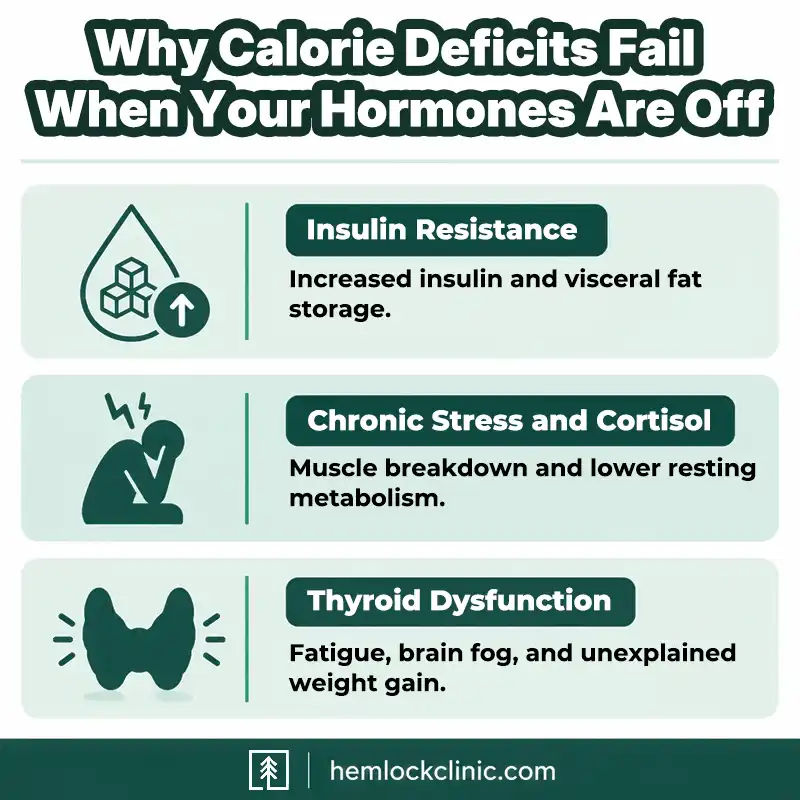
When you severely restrict calories while dealing with a hormone imbalance, you trigger a biological survival response. The body interprets the sudden drop in energy as a state of starvation.
This perceived threat causes an increase in stress hormones and a measurable decrease in active thyroid hormones. As a direct result, your resting metabolism slows down. Instead of burning stored fat, your body holds onto incoming calories to conserve energy.
Insulin Resistance: The Driver of Stubborn Belly Fat
Insulin is a primary driver in weight management. When you develop “insulin resistance,” your cells stop responding properly to the signal to absorb sugar from your blood. To force the sugar into your cells, the pancreas overcompensates by pumping out even more insulin.
This creates a physical barrier to weight loss. According to research indexed in PubMed, having high levels of circulating insulin physically blocks the body from breaking down stored fat. Unmanaged blood sugar directly encourages the body to store stubborn visceral fat around the midsection.
For patients facing this roadblock, managing insulin resistance is the absolute first step to correcting hormone function and achieving sustainable weight loss.
How Chronic Stress and Cortisol Suppress Your Metabolism
Chronic daily stress keeps cortisol (the primary stress hormone) artificially elevated. The Endocrine Society notes that sustained high cortisol breaks down active muscle tissue, which further lowers your resting metabolic rate.
It also triggers physical cravings for high-sugar foods. To protect your vital organs from prolonged stress, this hormone encourages your body to retain weight directly around your abdomen.
Thyroid Dysfunction: Sluggish Energy and Unexplained Weight
The thyroid gland acts as the engine of your metabolism. When it underproduces essential hormones, that engine slows to a crawl.
Patients frequently experience chronic daily fatigue, brain fog, and unexplained weight gain even when maintaining a healthy diet. Once a comprehensive blood test confirms this deficiency, treating thyroid dysfunction is the clear medical solution to getting your metabolism running efficiently again.
Clinical Case Observation: The Limits of Cardio
Recently at Hemlock Clinic, a 42-year-old patient presented with severe exhaustion. She was completing 45 minutes of cardio daily and eating only 1,200 calories, yet she had gained 12 pounds over six months. By running a comprehensive blood panel, Dr. Sran identified that her body was actively blocking thyroid hormones to conserve energy, alongside early-stage insulin resistance. Her intense workouts were elevating her cortisol and further suppressing her metabolism.
We stopped the aggressive calorie deficit, prescribed targeted metabolic medication, and shifted her routine to low-intensity strength training. Within 8 weeks on our medical weight loss programs, her lab results normalized, and she comfortably lost 14 pounds without extreme restriction.
Medical Protocols for Stubborn Hormonal Fat
Generic commercial diets fail repeatedly because they ignore these underlying biological breakdowns. The Hemlock Clinic protocol treats the root cause with close medical supervision.
Comprehensive Blood Testing: No Guesswork
We rely on objective data when evaluating your metabolism. Our approach begins with precise lab tests to map out exactly how your body is functioning, including:
- Fasting Insulin & A1c: To identify hidden blood sugar roadblocks preventing fat loss.
- Comprehensive Thyroid Panel: Moving past basic checkups to evaluate how much active thyroid hormone your body is actually utilizing.
- Cortisol Markers: To measure your physiological stress levels.
- Hormone Binding Proteins (SHBG): To assess if your hormones are freely available for your cells to use.
Personalized Medication and Clinical Support
Based entirely on your extensive blood work, Dr. Manpreet Sran creates a highly targeted treatment plan. This may include prescription medications to improve insulin sensitivity, precise thyroid hormone support, and specialized nutritional guidance designed to repair your metabolism safely.
When Unexplained Weight Gain Requires a Doctor

There is a distinct point where it is necessary to stop dieting and seek a professional medical evaluation. It is time to consult a physician if you notice any of these clinical red flags:
- Rapid, unexplainable weight gain concentrated primarily around the abdomen.
- Chronic exhaustion that does not improve after a full night of rest.
- Weight that remains stagnant regardless of strict dietary changes.
- Intense, physical cravings for sugar shortly after eating a balanced meal.
Stop fighting your biology alone. We provide welcoming, expert care in Redmond, WA, and are currently accepting new patients who are ready to take a clinical approach to their health.
Frequently Asked Questions About Hormonal Weight
Can changes in female hormones like estrogen cause weight gain?
Yes. While insulin and cortisol are major metabolic drivers, fluctuations in estrogen and progesterone—especially during perimenopause and menopause—dramatically alter body composition. A drop in estrogen often redistributes fat storage directly to the abdomen, independent of your daily calorie intake.
Is Polycystic Ovary Syndrome (PCOS) considered a hormonal weight issue?
Absolutely. PCOS is deeply tied to metabolic function. Women with this condition frequently experience severe insulin resistance alongside elevated male hormones (androgens). This combination creates significant metabolic resistance, making weight loss exceptionally difficult without medical therapies to address the underlying endocrine disorder.
How long does it take to see results when treating my metabolism medically?
Because a clinical program focuses on repairing metabolic function rather than forcing temporary starvation, the timeline is individualized. However, patients typically notice distinct improvements in daily energy, sleep quality, and physical cravings within the first few weeks. Sustainable changes on the scale follow naturally as the metabolism recovers its healthy baseline.
Looking for Personalized Primary Care?
Schedule a visit with Hemlock Clinic in Redmond to discuss your health concerns and the next appropriate step in your care.
Schedule Your VisitDr. Manpreet Sran, MD
Board Certified Internal Medicine PhysicianMedically reviewed on November 23, 2026.
View Provider Profile →
