
Recognizing the Early Clinical Signs of PCOS in Women Under 30
Medical Disclaimer: The information provided in this article is for educational purposes only and should not replace professional medical diagnosis, evaluation, or treatment. All treatments at Hemlock Clinic are prescribed based on individualized clinical assessment.
Many young women spend their twenties dealing with sudden physical changes, only to have doctors attribute them to normal stress from college or career pressures. When stubborn acne or irregular periods develop unexpectedly, they are often the first hidden warning signs of a hormone imbalance. Catching these shifts early stops worse health and fertility issues down the road. As a trusted medical clinic in the Greater Seattle area, Hemlock Clinic believes in taking action early instead of just waiting and watching.
Why PCOS Symptoms in Your 20s Are Often Ignored
It is incredibly common for young women to face delays in getting answers. Issues like ongoing fatigue, mood swings, and irregular cycles are frequently blamed on a busy lifestyle.
“Research from the American College of Obstetricians and Gynecologists (ACOG) highlights that the classic signs of PCOS—such as irregular ovulation and high male hormone levels—are frequently missed in younger patients because they look a lot like normal life and body changes during early adulthood.”
American College of Obstetricians and Gynecologists (ACOG)
The Hidden Mask of Birth Control Pills
Many teenage and young adult women are put on birth control pills to regulate their periods. While helpful for a time, this medication completely hides the true early signs of PCOS. It is usually only when women stop taking the pill in their late twenties that a severe hormone imbalance suddenly comes to the surface. Because routine checkups often miss these hidden shifts without specific lab work, scheduling a thorough annual physical exam is key to catching them.
The First Physical Warning Signs of High Androgens
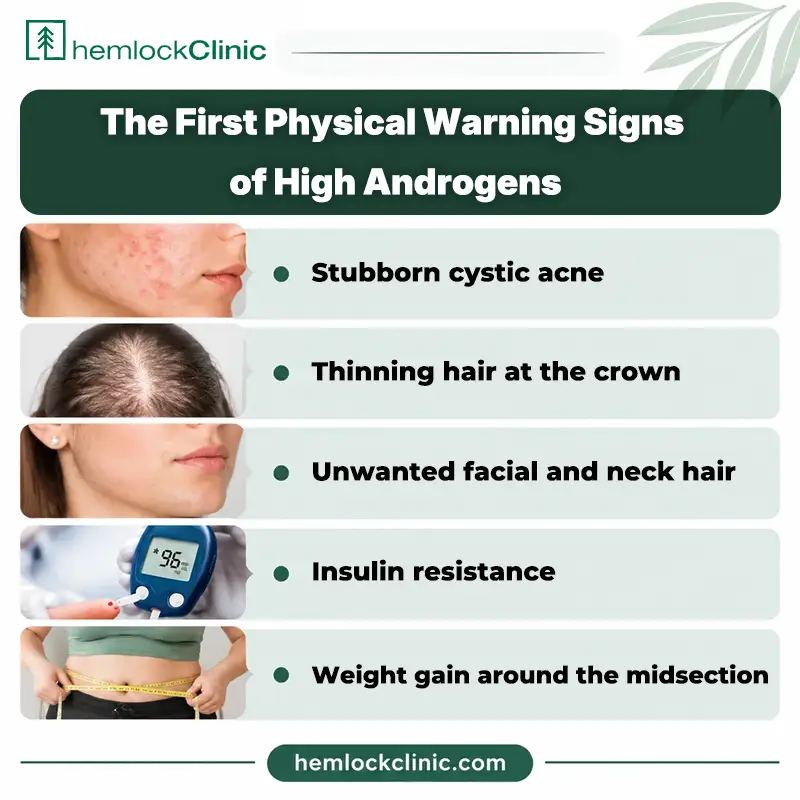
When your body produces higher levels of male hormones (androgens), it creates distinct physical changes that people often mistake for simple cosmetic flaws. For example, deep, stubborn cystic acne clustered tightly along your jawline and chin is a major clinical sign of an internal hormone imbalance. In the same way, unexplained thinning hair at the top of your head or unwanted hair growth on your face and neck aren’t solved with over-the-counter face washes; they require a real medical evaluation.
Stubborn Weight Changes and Insulin Resistance
The early signs of PCOS are deeply connected to how your cells handle sugar (insulin resistance). When your cells stop responding properly to insulin, your body suddenly starts holding onto weight—especially right around your midsection—even if your diet and workouts haven’t changed at all.
This is not a lack of willpower; it is a physical glitch in your metabolism. Fixing this type of hormone-driven weight gain requires medical help rather than another restrictive diet. By directly targeting how your body processes sugar, our medical weight loss programs safely bring your system back into balance.
The Clinical Process: Getting a Real Diagnosis
Online symptom checkers cannot give you an answer or diagnose an endocrine disorder. Finding out if you have undiagnosed PCOS requires specific medical testing to map out exactly where your body’s signals are breaking down.
Take a recent 27-year-old patient who came to Hemlock Clinic after stopping birth control. She suddenly developed deep jawline cystic acne and started packing on weight around her stomach. Her previous doctor told her to eat less and use a harsh acne wash. When we ran a targeted hormone panel, we found high androgens and insulin resistance. We skipped the topical creams entirely and prescribed a targeted medication to help her body handle insulin, successfully clearing up her skin and weight stall within three months.
Comprehensive Hormone and Insulin Panels
A true diagnosis requires precise blood work checking things like Luteinizing Hormone (LH), Follicle-Stimulating Hormone (FSH), free testosterone, and fasting insulin to see the exact size of the imbalance. We don’t guess based on standard, one-size-fits-all charts.
Is It Just Cosmetic, or Is It Hormonal?
| What You Might Notice | What Doctors Often Mistake It For | What It Actually Means (PCOS Indicator) |
| Jawline Cystic Acne | Regular adult-onset breakouts | High free testosterone levels in the blood. |
| Belly Weight Gain | Bad diet or lack of exercise | Insulin resistance forcing fat storage around the middle. |
| Irregular Periods | Stress from work or school | Your ovaries failing to release an egg regularly. |
Dr. Sran uses these exact lab numbers to build a custom, long-term care plan. By fixing the root internal cause instead of just treating surface symptoms, our structured approach to PCOS management gives you real, lasting answers.
Take Control of Your Hormone Health Today
Leaving these early warning signs alone raises your risk of developing type 2 diabetes or facing severe fertility challenges in your thirties. You do not have to accept sudden physical changes and constant exhaustion as your new normal.
Stop ignoring the red flags and get a clear, definitive medical diagnosis. We provide welcoming, expert care and are currently accepting new patients for comprehensive hormone evaluations in Redmond, WA.
Frequently Asked Questions About Early PCOS Detection
Can I have PCOS in my 20s if I am not overweight?
Yes. This is a very common and misleading myth. “Lean PCOS” affects a significant percentage of women who maintain a completely normal weight (BMI) but still struggle with high androgens, cystic acne, and hidden insulin resistance. Weight gain is a common symptom, but it is never a requirement for a diagnosis.
Do I need a pelvic ultrasound to find out if I have PCOS?
Not always. According to standard medical guidelines (the Rotterdam Criteria), a patient only needs to meet two out of three benchmarks: irregular periods, signs of high androgens (through blood work or physical symptoms), or polycystic ovaries found on an ultrasound. If your blood tests and symptoms confirm the first two, a formal diagnosis can often be made without needing an immediate scan.
Will a PCOS diagnosis in my twenties mean I can’t have kids later?
No, a diagnosis does not mean you cannot conceive. It simply means your ovulation pattern is unpredictable right now. By catching the hormone imbalance early in your twenties, Dr. Sran can use targeted treatments (like Metformin, or ovulation support when you are ready to start a family) to protect your long-term reproductive health.
Looking for Personalized Primary Care?
Schedule a visit with Hemlock Clinic in Redmond to discuss your health concerns and the next appropriate step in your care.
Schedule Your VisitDr. Manpreet Sran, MD
Board Certified Internal Medicine PhysicianMedically reviewed on November 18, 2026.
View Provider Profile →
