
7 Subtle Signs of Low Testosterone in Men Over 40
Medical Disclaimer: The information provided in this article is for educational purposes only and should not replace professional medical diagnosis, evaluation, or treatment. All treatments at Hemlock Clinic are prescribed based on individualized clinical assessment.
Many driven men in their forties notice a steady drop in physical energy and daily drive, only to have standard doctors dismiss it as a normal part of getting older. Waking up completely exhausted even after eight hours of sleep isn’t just work stress; it is a clear warning sign of an underlying hormone shift. Catching this drop early prevents long-term health and weight issues. As a trusted medical clinic in the Greater Seattle area, Hemlock Clinic uses advanced hormone testing instead of guesswork to help you get your baseline back.
Why Low Testosterone Is Often Mistaken for “Normal Aging”
There is a big physical difference between a slow, natural change in hormones over decades and a sharp clinical drop that requires medical help. Because symptoms creep up over several years, it is hard to notice how much your energy and strength have actually deteriorated.
“According to the American Urological Association, while a slight decrease in testosterone is expected as men age, a drop below 300 nanograms per deciliter (ng/dL) points to clinical hypogonadism—a true hormone deficiency that requires professional medical care.”
American Urological Association (AUA)
Normal Aging vs. A Real Hormone Drop
| Health Marker | Normal Age-Related Change | Clinical Low Testosterone |
| Energy Levels | Mild tiredness after a long, physically demanding day. | Deep, cellular exhaustion that a full weekend of sleep cannot cure. |
| Body Shape | A slight decrease in muscle mass over many years. | Rapid muscle loss and a sudden buildup of stubborn belly fat. |
| Focus & Mind | Occasional forgetfulness or distraction. | Severe afternoon brain fog and an uncharacteristic loss of drive and focus. |
The 7 Subtle Signs Your Hormones Are Dropping

Most websites focus only on late-stage sexual symptoms, missing the early warning signs entirely. Here are seven subtle clues that your endocrine system needs a medical evaluation.
1. Unexplained Fatigue and Broken Sleep
Low testosterone exhaustion isn’t just feeling sleepy. Low hormone levels actively disrupt your deep REM sleep cycles. Experiencing this level of ongoing burnout means you need a full diagnostic workup to rule out other issues. We strongly recommend scheduling an annual physical exam to check your baseline and catch these sleep disruptions early.
2. Brain Fog and Lost Focus
Testosterone receptors are heavily concentrated in the human brain. A sharp drop in this hormone directly causes afternoon brain fog and a lack of sharp focus. High-performing men often mistake this sudden mental fatigue for professional burnout.
“Testosterone deficiency is closely linked to brain fog, trouble concentrating, and mood changes, often mimicking the symptoms of clinical depression in men over forty.”
3. Mood Changes and Loss of Competitive Drive
Beyond focus, testosterone helps regulate brain chemicals like dopamine. A sudden, uncharacteristic loss of ambition, drive, or patience under stress is a primary sign that your hormone levels have dipped.
4. Muscle Loss and Slow Workout Recovery
Continuing to lift weights with low testosterone yields zero results. When muscle soreness lasts for days longer than it used to, it points directly to poor cellular recovery caused by a hormone deficiency.
5. Stubborn Belly Fat Buildup
Testosterone plays a major role in how your body handles sugar and stores fat. When levels drop significantly, your cells become resistant to insulin, forcing your body to store calories directly around your abdomen as visceral fat, no matter how clean you eat.
6. Unexplained Mild Anemia (Low Red Blood Cells)
Testosterone stimulates your bone marrow to make red blood cells. A subtle sign of low testosterone is a routine blood test showing mild, unexplained anemia or a sudden drop in hemoglobin levels when there is no other bleeding present.
7. Early Bone Density Loss
While often thought of as a women’s health issue, men rely on testosterone converting to estrogen to keep bones strong. A silent symptom of long-term low testosterone is early bone thinning (osteopenia) or unexplained joint aches.
The Medical Approach: How We Diagnose Low T
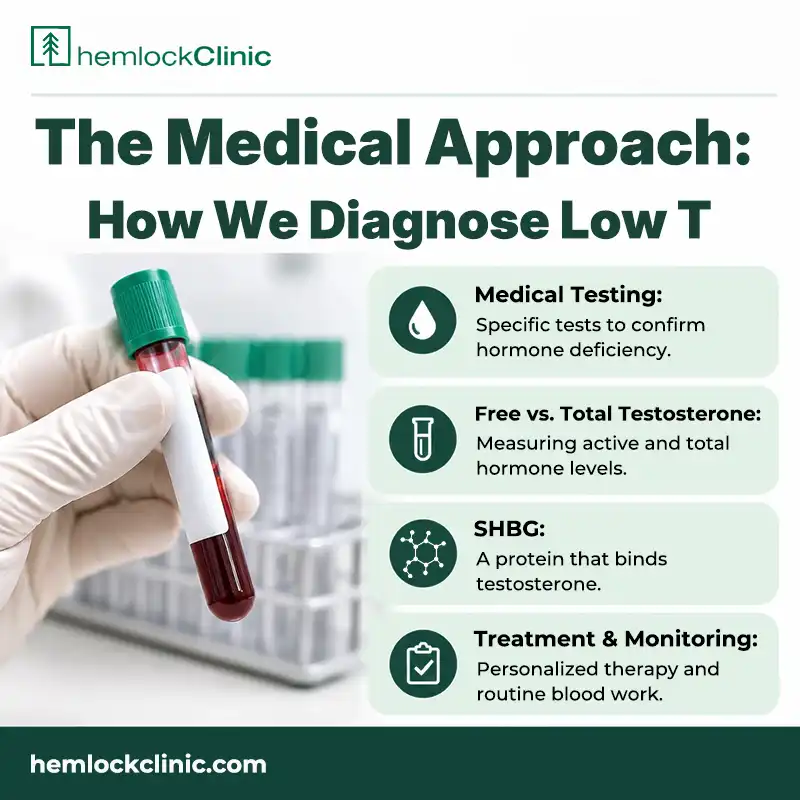
Online quizzes cannot diagnose a complex hormone disorder. Confirming a true deficit requires specific medical testing to look at how your body handles and binds its hormones.
Checking Free vs. Total Testosterone
Standard family doctors often test only “Total Testosterone,” which can give a very misleading picture. At Hemlock Clinic, we test Free Testosterone, Estradiol, and Sex Hormone-Binding Globulin (SHBG) to see the exact size of the problem.
- Total Testosterone: The total amount of the hormone in your blood, much of which is locked up by proteins and unusable.
- SHBG: A protein that traps testosterone, rendering it inactive if levels are too high.
- Free Testosterone: The active, unbound hormone your cells actually use for energy, muscle repair, and mental focus.
When to Consider Hormone Replacement Therapy
Dr. Manpreet Sran uses targeted medications and close medical supervision to safely bring your hormone levels back to a healthy baseline. For example, a 46-year-old patient recently came to us dealing with severe brain fog and an inability to recover from basic workouts. While his previous doctor told him his total testosterone was “normal,” our advanced panel revealed very low free testosterone trapped by high SHBG.
By prescribing custom testosterone replacement therapy, we safely restored his active hormone levels. This therapy is carefully monitored through routine blood work to protect your heart and prostate health every step of the way.
Take Control of Your Vitality Today
Ignoring these subtle signs is risky and can lead to metabolic syndrome or severe bone thinning over time. A major drop in testosterone is a treatable medical condition, not an inevitable life sentence.
Stop accepting a declining quality of life and get a clear, medical diagnosis. We provide welcoming, expert care and are currently accepting new patients for comprehensive evaluations in Redmond, WA.
Frequently Asked Questions About Men’s Hormonal Health
Does testosterone replacement therapy (TRT) cause prostate cancer?
No. Extensive clinical research has debunked the old myth that TRT causes prostate cancer in healthy men. However, if a patient already has an undiagnosed prostate tumor, introducing testosterone can speed up its growth. This is why thorough prostate screening (PSA testing) is a mandatory safety requirement before and during our treatments.
Can low testosterone cause hair loss?
While male pattern baldness is mostly driven by genetics and DHT, severely low testosterone can cause a loss of body and facial hair. Unexplained thinning of hair on your arms, legs, or chest can be a subtle sign of an endocrine imbalance.
Will treating low testosterone hurt my fertility?
Yes, standard TRT stops your body’s natural sperm production, which can impact fertility. For younger men or those planning to start a family, Dr. Sran uses alternative clinical protocols (like precise doses of HCG or Clomiphene) to boost your natural testosterone levels without shutting down fertility.
Looking for Personalized Primary Care?
Schedule a visit with Hemlock Clinic in Redmond to discuss your health concerns and the next appropriate step in your care.
Schedule Your VisitDr. Manpreet Sran, MD
Board Certified Internal Medicine PhysicianMedically reviewed on November 20, 2026.
View Provider Profile →
